

What Can Grow in 27 Years? A Forest, a Classroom and a Friendship

By YuHo China

An American teacher, 50,000 trees, and a reminder of why people-to-people exchange still matters.

In 1999, Ronald Sakolsky arrived in Luoyang as part of a US-China teacher exchange programme. He came to teach English for a year, curious about a country he had mostly known from a distance. During that year, he saw a television report about Yin Yuzhen, a woman who spent years trying to hold back the sands of the Maowusu Sandy Land in northern China by planting trees around her home. Her persistence moved him so deeply that he raised US$5,000 to support her work. At the time, neither of them could have known what that small act of generosity would become.
More than a quarter-century later, Sakolsky returned to China. The saplings bought with that donation had grown into a forest of more than 50,000 trees. Yin had continued planting for decades, turning what had once been a struggle for survival against the desert into a life’s work. When Sakolsky returned to Inner Mongolia in August 2026 and saw the landscape again, he called the transformation a “miracle”. The reunion was moving not simply because two old friends had found one another again, but because they were standing inside the physical result of something that had begun with one person seeing another person’s story and deciding to help.
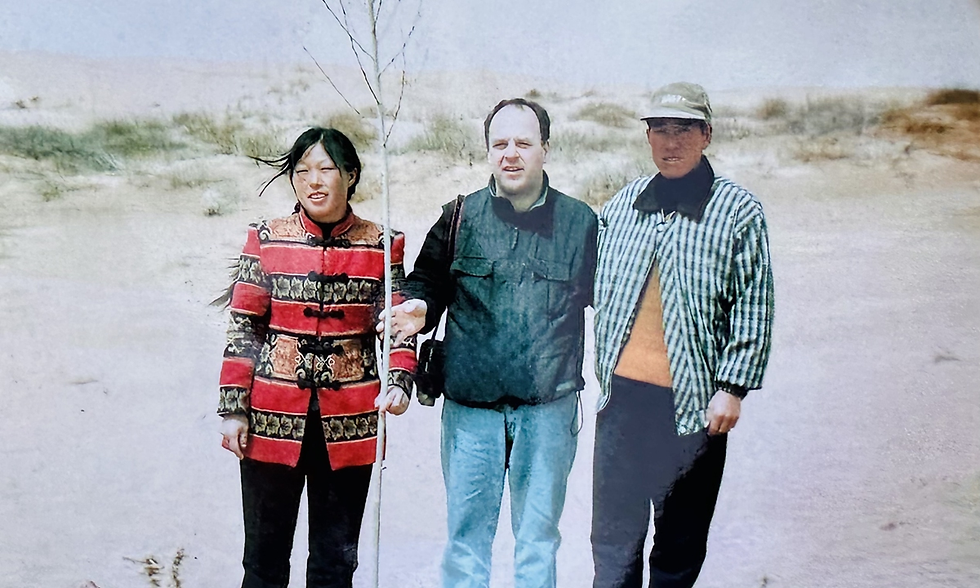
In 1999
Yet the forest was only one part of his homecoming. Sakolsky also returned to the school in Luoyang where he had taught in 1999. On the classroom blackboard were the words “Welcome home”. Former students came back to see him, some travelling long distances to be there. They were no longer teenagers in an English class; they had become teachers, doctors, professors, entrepreneurs, bankers and professionals with families and careers of their own. Looking at them, Sakolsky made the same comparison that sits at the heart of his story: a teacher plants a seed, a student grows, and what has been passed on can continue far beyond the original classroom.

In 2026
That comparison is particularly powerful for anyone working in international education. We are accustomed to measuring programmes through immediate outcomes: what students learned, which places they visited, what skills they developed, what they wrote in their reflections, and whether the experience met its academic objectives. Those things matter. International education should be purposeful, structured and intellectually serious. But Sakolsky’s story is also a reminder that some of its most important outcomes cannot be measured on the final day of a programme.
A conversation can alter an assumption. A teacher can introduce a different way of seeing the world. A student can meet someone whose life makes a distant society suddenly feel human and real. Most of these moments seem small when they happen. Occasionally, they keep growing for decades.
This feels especially relevant when we think about China today. China is one of the most discussed countries in the world. Young people encounter China through headlines, political debate, online commentary, products, brands, and technologies long before they ever set foot in the country. There has perhaps never been more information about China available internationally. But information is not the same thing as understanding. A country can be highly visible and still be poorly understood, because understanding a society requires more than accumulating facts about it. It requires context, questions and, wherever possible, direct encounters with the people who actually live there.
Sakolsky’s return also offered a quiet glimpse of how much China itself has changed. He returned not only to a forest that had replaced sand, but to a Luoyang very different from the city he remembered, and to former students whose lives reflected the social and professional transformations of the decades in between. China is not a fixed story to be explained from the outside; it is a society still changing fast. For international students, understanding that China means seeing more than landmarks. It means entering classrooms, companies and communities, and asking how people themselves understand the changes around them.

That is why openness matters at the human level: the ability of ordinary people to encounter one another with enough time and context. Sakolsky did not arrive in China as a public figure. He arrived as a teacher, and his friendship with Yin began simply because he was there, paying attention, and willing to respond.
💡This is close to why we built YuhoChina.
Our programmes take students into Chinese classrooms, companies and communities — most recently, 60 university students in Yiwu, visiting factories and talking with traders to see how a product actually gets from idea to market. The aim is not to replace one simplified narrative with another, or to tell students what to think. It is to give them enough access, context, and human contact to ask better questions and reach their own conclusions. We can measure what they learn by the end of the week. What we hope for is what Sakolsky's story shows: the curiosity and relationships that keep growing long after they get home.

60 students visited Yiwu trade market
Twenty-seven years ago, an American teacher came to China for one year. Some of what he planted grew in the sand. Some of it grew in a classroom. And some of it grew between people.
Perhaps the strongest bridges between countries do not look like bridges at all. Sometimes, they look like a classroom. Sometimes, they look like a tree.

Comments