

If you want to look at the future, you look at China

By YuHoChina
KEY takeaways from CIIC London 2026

Spent the day at Bush House for the Harvard China Innovation and Investment Conference (CIIC) London Summit, themed Shaping Enduring Futures. It pulled together investors, operators, academics and policymakers around one hard question: how do innovation, capital and institutions hold together when geopolitics, technology and the economy are all shifting at once?
The wider argument running through the day was that the entire model of UK–China commercial engagement is being rewritten — and that success in it needs four qualities: dialogue, speed, efficient innovation, and the patience to build trust.
A few takeaways:
1. The innovation story has flipped, and fast.
Professor Kerry Brown (Director of the Lau China Institute, KCL) opened with a line: a decade ago, the working assumption was that China sat in a technology and intellectual deficit. That assumption is gone.

He walked through the numbers — R&D spending in the current Five-Year Plan running at roughly US$380bn a year (China moved from below Japan in 2007 to near-US levels in under twenty years), the largest STEM graduate and PhD pipeline in the world, and patent and peer-reviewed research output that has gone from nowhere to global-leading inside fifteen years. DeepSeek, BYD, EV batteries, humanoid robotics — no longer the exceptions. (He visited a science-tech zone in Hangzhou in March and came away struck by the robotics capacity.)
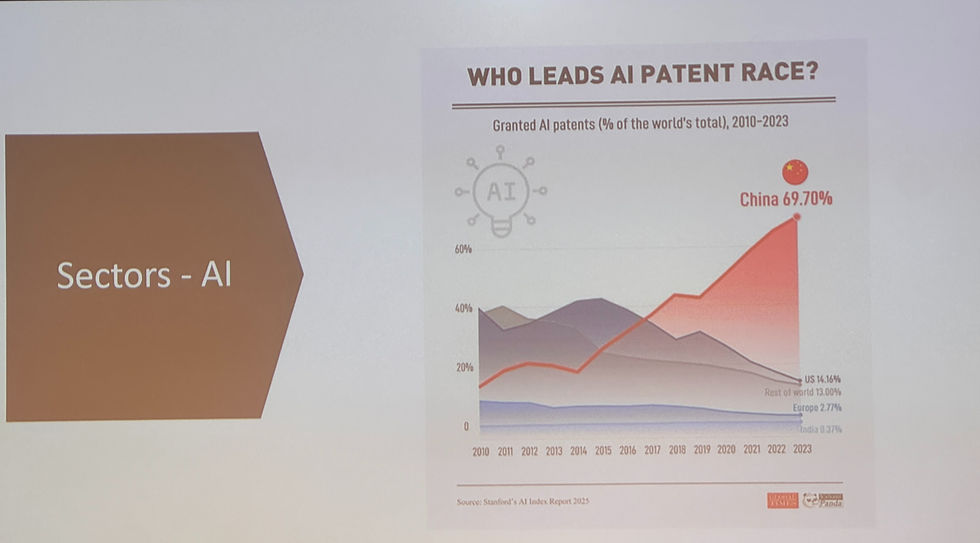
The same shift shows up in the university tables: Chinese institutions are climbing while European and American ones hold their position.
A radical change.
His sharpest point was: the old belief that breakthrough innovation requires democratic systems has been disproven. And the opportunity cost is no longer what it was ten years ago. Missing the moment now costs far more to catch up on — which is exactly why working with China across so many fields has become hard to avoid.
2. Disagreement does not mean disengagement.
The easy narrative is that China can be politically resisted and practically ignored. The evidence says otherwise. China is now the UK's second-largest research partner after the US, and British and Chinese academics co-author more work than we do with Germany, France, or Japan. On climate, AI safety, and life sciences, practical cooperation remains real.
The more comfortable illusion — that policymakers can simply say “we don’t agree with China, so we won’t engage” — is fading. More and more decision-makers now treat China as an unavoidable factor in the calculation, not an optional one.
3. The dependency dilemma is real.
European projects are wrestling with how much Chinese technology is "too much". The pragmatic answer wasn't refusal, but learning while you build. There's a historical mirror here. European companies are now learning Chinese technologies while deliberately keeping part of that capability independent for themselves, much as Chinese firms did with Western technology decades ago.
The proverb Brown left us with was 同舟共济 — crossing the river in the same boat.
We don't need to agree on everything to navigate the journey together. But we do need to keep showing up, keep looking, and keep learning first-hand.
It's what YuhoChina is built around. Every session today made the same underlying argument: you cannot outsource your understanding of China to a news feed. We design curriculum-linked programmes that put students and leaders directly inside the country — its campuses, companies and communities — because first-hand exposure is the only thing that actually moves the needle on China literacy.


Comments